
Designer Anti Theft Bags: How to Get Luxury Style and Real Security
Quick Answer: Designer Anti-Theft Bags Combine Style and Security
A designer anti-theft bag pairs the look and materials of a luxury handbag with real security engineering: slash-resistant panels, lockable zippers, RFID-blocking pockets, and a cut-resistant strap. Brands like Thafael build these features in from the start rather than bolting them onto an existing fashion template, so the bag reads as a premium accessory first and a security tool second.
Why Designer Anti-Theft Bags Are Suddenly in Demand
Pickpocketing in major tourist cities has climbed to levels most travelers can no longer ignore. Paris accounts for roughly 16.5% of all theft-related tourist reviews worldwide, according to a 2025 Radical Storage analysis of more than 13,000 reviews. Rome has seen pickpocketing surge an estimated 68% since 2019, and Barcelona's Mossos d'Esquadra recorded over 100,000 pickpocketing incidents in a single recent year, with many more going unreported. These numbers have pushed women to rethink what they carry abroad — searching not just for an anti-theft bag, but for a designer anti-theft bag that still looks like a premium handbag rather than a piece of tactical gear.
A designer anti-theft bag is exactly what it sounds like: the clean lines, structured silhouette, and premium materials of a luxury handbag, with serious security features hidden inside — slash-resistant fabric, locking zippers, RFID-blocking pockets, and a cut-resistant anchor strap, all engineered to deter common theft techniques without announcing to a crowded metro platform that you're carrying a fortress.
Here's the core problem: most classic anti-theft bags lean sporty or utilitarian, and most designer bags ignore travel security entirely. Finding one that does both well takes effort — which is exactly the gap a small number of specialist brands, including Thafael, are building for.
This article covers the security technologies that actually matter, what makes a bag read as high-end rather than technical, real-world scenarios from airports to museums, and how to choose the best designer anti-theft crossbody bag or purse for your next trip. For a closer look at Thafael's own approach, see the anti-theft crossbody bag features breakdown.
What Makes a Bag "Anti-Theft"? Core Security Features Explained
An anti-theft bag is engineered to slow or stop four common theft techniques: slash-and-grab, stealth unzipping, bag snatching, and RFID skimming. A strong design addresses several of these at once rather than relying on one feature alone.
The essential security features to look for in any anti-theft bag — designer or otherwise:
-
Slash-resistant fabric — panels reinforced with steel mesh or high-strength fiber layered behind the exterior shell to resist blade cuts
-
Reinforced straps — internal steel cable or cut-resistant material woven into the shoulder strap so it can't be quickly sliced
-
Lockable zippers — zipper pulls that clip into loops or anchor to D-rings, preventing a pickpocket from silently sliding them open
-
A cut-resistant anchor strap — a detachable, lockable strap that lets you tether the bag to a chair leg, luggage handle, or other fixed object
-
RFID-blocking pockets — lined compartments that shield contactless cards and passports from electronic skimming
-
Hidden or secured compartments — back pockets and internal sleeves positioned where a thief can't easily reach
At minimum, a bag marketed as anti-theft should have lockable zippers and RFID-blocking pockets. Pacsafe, Travelon, and Sherpani are established names in this space — Travelon in particular builds around a five-point security system covering closures, straps, and interior protection.
What separates a designer anti-theft bag from a purely functional one is execution: Thafael integrates these mechanisms invisibly, so the bag keeps a refined, fashion-forward appearance instead of looking like security gear. Quality hardware — solid metal D-rings, robust carabiners, smooth but secure zipper pulls — matters just as much as the fabric, especially at stress points like strap attachments and anchor clips.
What Makes a Bag Look Designer-Level and Luxurious?
Many anti-theft bags fail on aesthetics because they prioritize function over form. If you want a bag that reads as designer at a glance, here's what actually signals it.
Silhouette and proportions. A luxury-looking handbag has minimal external seams, clean lines, balanced proportions, and a structured shape that holds itself upright. Pockets are placed so the exterior stays sleek — no bulging hardware or oversized flaps that read as technical.
Materials. Full-grain leather or high-performance nylon adds both durability and visual weight. In vegan and eco-conscious lines, high-grade microfiber leather and cactus leather can mimic the depth and grain of animal leather convincingly. What matters most is even dye, a soft but firm hand-feel, and consistent surface texture.
Hardware and finishing. Weighty but understated metal in muted finishes — brushed gold, gunmetal, polished silver — signals care. Discreet logo placement keeps the focus on craftsmanship. Neat stitching with consistent spacing (roughly 7–9 stitches per inch) and tight bar-tack reinforcement at stress points separate a well-made bag from a cheap one.
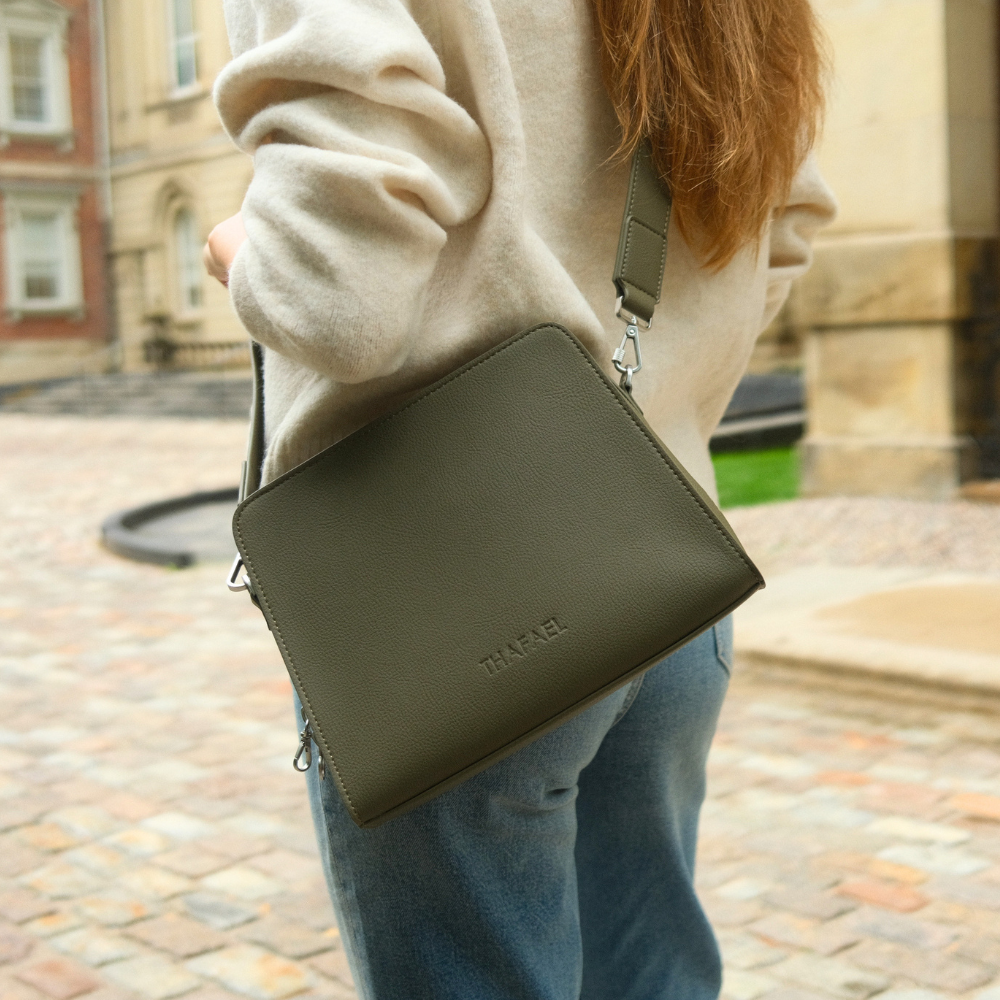
Thafael designs its stylish anti-theft crossbody bags for women around these exact cues — microfiber leather, matching hardware finishes, structured-but-soft forms that echo the Thafael anti-theft crossbody bag concept. The result reads as a premium city handbag, not a technical travel accessory.
See it in person: the La Trotteuse anti-theft crossbody bag is Thafael's clearest example of this — a Paris-inspired silhouette that hides a full security system behind a genuinely minimalist exterior.
Why True Designer Anti-Theft Bags Are Hard to Find
Search "designer anti-theft crossbody bag" and you'll mostly find sporty or overtly technical styles. The reason comes down to design tension.
Security hardware adds weight and bulk. Steel mesh can distort the drape of soft materials. Locking mechanisms and anchor straps require extra pattern complexity and meaningfully increase production cost — exactly the compromises luxury fashion brands tend to avoid. Most designer labels skip comprehensive anti-theft engineering because visible locks, cable straps, or stiff linings dilute their signature silhouette.
On the other side, established travel-security brands like Pacsafe and Travelon execute the security engineering well, but design for function first. Their bags are practical and reliable, and look the part — more travel gear than something you'd carry into a Parisian restaurant.
That gap is real, and it's what Thafael and a small number of other specialist brands are building for — designing for elegance and security from day one, rather than retrofitting security into a fashion template or dressing up a utility bag. Our comparison of Thafael vs. Travelon vs. Pacsafe anti-theft crossbody bags breaks down exactly where each approach lands.
Key Anti-Theft Features to Look For in a Designer-Looking Bag
Not every bag marketed as "secure" delivers real protection. Here are the concrete checkpoints that matter:
-
Genuine slash-resistant panels in the bag body and strap, with steel or high-strength fiber reinforcement (not just "extra durable fabric")
-
Lockable zippers on every exterior opening
-
At least one RFID-blocking pocket sized for a passport and multiple cards
-
An integrated cut-resistant anchor strap or lockable attachment point
Good design hides all of this. Zipper pulls that hook onto D-rings near the gusset look like ordinary hardware. Anchor clips can be concealed behind small leather tabs. Slash-resistant mesh can be laminated inside the lining, invisible from the outside.
When you're evaluating a product listing, look for named materials — stainless steel mesh, Dyneema® fiber, or an equivalent cut-resistant material — rather than vague claims. If a brand won't name what's inside the panels, that's a red flag.
Thafael's La Trotteuse integrates lockable zippers, slash-resistant straps, a hidden back zipper pocket, RFID-blocking card slots, and a passport compartment, all inside a minimalist, Paris-inspired exterior — see the full rundown on the anti-theft crossbody bag features page. Its standout detail is a lockable, detachable strap that lets you anchor the bag without any visible security hardware disrupting the look.
Materials and Construction: From Slash-Resistant Fabric to Eco-Luxury Leathers
A bag's security and its appearance both depend on materials and construction quality, not just the design sketch.
Common anti-theft construction pairs a polyester or nylon shell with hidden stainless steel mesh, high-denier weaves, and reinforced bar-tacking at strap junctions. Pacsafe's eXomesh® system, for example, embeds lightweight steel wire mesh throughout the bag body for slash resistance — a useful reference point for what "real" slash protection looks like under the marketing language.
For a designer anti-theft bag specifically, the exterior needs to do more work: microfiber leather, cactus leather (such as Desserto®), or smooth vegan leather that mimics a genuine designer handbag, while the slash-resistant lining stays hidden underneath. Water-resistant treatment on top adds everyday practicality without changing the look.
Construction details worth checking: double-stitched stress points, reinforced gussets, and secure rivets on strap anchors that resist forceful tugging or cutting. This is where a bag fails first if construction is cut corners, and why well-built anti-theft travel products emphasize both materials and construction quality.
Thafael uses eco-conscious premium materials, including cactus-based leather in select colors, with slash-resistant linings engineered to feel like a refined handbag while standing up to daily commuting and long-haul flights — see the full case for the best anti-theft bag for Europe.
Locking Zippers, Anchor Straps, and Hardware: Quiet Security Mechanisms
Most theft in crowded metros, trams, and markets happens through silent unzipping or a quick snatch. That makes hardware design the part that actually matters most day to day.
Lockable zippers vary in mechanism — some clip into a small loop near the gusset, others use carabiner-style clips or push-and-turn knobs. What matters is that each one slows a thief down while staying easy for you to use. This is the single biggest deterrent against quiet, in-crowd theft.
Cut-resistant straps are reinforced with steel cable or Dyneema, so the strap looks and feels like ordinary leather or fabric while being close to impossible to slice with a pocket knife.
Secure attachment points let you lock the bag to something fixed — a café chair, train seat, or luggage handle — creating a real barrier against grab-and-run theft.
The best designer-level execution keeps all of this low-profile: hardware color-matched to the bag, clips positioned so you can operate them but a stranger wouldn't notice them. Thafael's anti-theft crossbody designs build lockable zippers and anchor points into the seams and strap attachments so they read as chic, not armored.
RFID-Blocking Pockets and Digital Security
RFID-blocking is the digital half of the equation. Modern passports issued after 2007 and most contactless cards carry chips that can theoretically be scanned at close range — the risk is highest in crowded transit hubs, where someone could hold a reader near your bag.
RFID blocking works through a metallic or conductive layer sewn into a pocket, effectively creating a small Faraday cage that blocks the 13.56 MHz frequency used by payment cards and e-passports.
In practice: keep your passport, primary cards, and transit pass in the RFID-blocking pocket while in transit or in crowds. You don't need to block everything at all times — overusing it just means more fumbling, which pulls your attention away from your surroundings, which is its own kind of risk.
RFID skimming is genuinely less common than classic pickpocketing, but it's a low-effort extra layer that makes sense in any travel bag. Thafael's designs build RFID-blocking card slots and a passport pocket directly into the interior layout, so the protection doesn't disrupt the bag's organization.
Designer Anti-Theft Crossbody Bags vs. Backpacks vs. Belt Bags
The same anti-theft principles apply across formats, but crossbody bags, backpacks, and belt bags each strike a different balance of style, capacity, and security.
Crossbody bags are the best fit if you want a designer handbag silhouette with real security. Because the strap crosses the body and the bag stays in your line of sight, crossbody design is inherently harder to snatch than a shoulder bag. A compact 2–5 liter bag is usually enough for city days, museums, and dinners — the Pacsafe CX Convertible Crossbody, for instance, expands from 3L to 5L if you want that flexibility.
Anti-theft backpacks suit commuters and air travel better, with room for a laptop, layers, and bulkier essentials — the Pacsafe V comes in a 16L capacity built for that kind of load. The tradeoff is that even a well-made anti-theft backpack tends to read as casual rather than designer, which matters less for a flight and more for a dinner reservation.
Belt bags and slings sit close to the body and can be very secure worn across the chest — the Pacsafe Metrosafe X Urban Sling offers 6L of capacity in that format. Capacity is the limiting factor, and the look tends toward sporty rather than designer.
Thafael focuses specifically on crossbody bags and travel purses because that format offers the best balance of elegance, hands-free practicality, and day-to-night versatility for international travel — it's why La Trotteuse works so well for sightseeing across Europe.
Choosing the Best Designer Anti-Theft Bag for Different Types of Trips
The right bag changes depending on the trip. A weekend city break asks for something different than a two-week multi-country itinerary or a daily commute.
City breaks (3–5 days). For short trips to Paris, Lisbon, or New York, a medium designer anti-theft crossbody is close to ideal — it's a big part of why so many women researching whether anti-theft bags are worth it for Europe land on a crossbody as the answer. It should hold a phone, slim wallet, sunglasses, a small camera, and a passport without looking bulky — dimensions around 8–10 inches wide and 2–3 inches deep tend to be the sweet spot. Budget options like the Travelon Classic Travel Bag ($50–$65) cover the security basics but lean utilitarian rather than designer.
Long international travel. Pair a designer anti-theft crossbody with a secure backpack: the crossbody stays on your body for your passport and essentials, the backpack carries layers and your laptop as your carry-on or personal item. Keep valuables in the crossbody at all times.
Commuting and work. A structured anti-theft purse with a back slip pocket or trolley sleeve doubles as an office bag and a flight-ready bag, which is genuinely useful if you travel often for work.
La Trotteuse is built for the first and third case — weekend trips and urban travel, with 12 pockets including a lockable back pocket and strap-anchoring options. For longer trips that need more capacity, pair it with a dedicated anti-theft travel backpack for luggage and layers.
Style, Outfits, and How to Avoid the "Tourist" Look
Most travelers want to blend in rather than visibly signal that they're carrying valuables, especially in European capitals with high pickpocket activity — your guide to not looking like a tourist in Europe covers the broader picture, and your bag plays a real part in that first impression.
Neutral, city-friendly colors — black, taupe, dark brown, navy, olive — with minimal branding make a designer anti-theft bag read as an ordinary luxury handbag. Skip flashy prints, reflective materials, or oversized logos that signal "tourist gear."
Outfit pairing matters too: a structured crossbody with a trench coat in Paris, a wool coat in London, or a linen dress in Barcelona becomes part of the outfit rather than a safety accessory bolted on. Match hardware tone to your jewelry preference, and avoid sporty details like reflective strips or visible carabiner clusters.
Thafael's shapes — rectangular flap silhouettes, subtle curves, refined strap attachments — are designed to hold up in cafés, museums, and semi-formal dinners alike. When a traveler ends up wearing the bag for daily life at home, not just on vacation, that's usually the clearest sign the aesthetics landed.
Organization and Capacity: Making a Designer Anti-Theft Bag Practical
A secure bag still has to be easy to live with hour after hour. Poor organization means more frequent opening and rummaging — and every time you dig through a bag in a crowd, that's an opening for a thief.
The ideal layout for a designer anti-theft purse or crossbody includes:
-
One main compartment for larger items (a slim water bottle, sunglasses case, small camera)
-
A smaller, lockable front or back zipper pocket for your wallet and passport
-
At least one RFID-blocking pocket with card slots for quick access to transit passes
-
Open slip pockets for phone and tickets, so you're not opening the main compartment repeatedly
-
Clear separation between compartments so you're not searching by feel
A hidden back pocket that sits against your body is one of the most effective places for high-value items. For day touring, 2–5 liters of capacity is usually enough — an overpacked bag is harder to manage, strains the strap, and makes you a more visible target.
Thafael places the heaviest items close to the body by design, improving comfort and reducing strain on the reinforced strap anchor points. Before a trip, it's worth rehearsing your own packing — decide where your passport, boarding pass, phone, and hotel key live so you minimize how often you open your most valuable compartments in public.
How and Where to Wear It for Maximum Safety
Even the best designer anti-theft bag can be compromised if worn carelessly. How you carry it matters as much as what's inside.
The optimal setup: strap across the body, bag resting at the front or slightly to the side, zipper facing upward and toward you. This is fundamentally different from a shoulder bag hanging behind your arm, which is far easier for a thief to access unnoticed.
In dense environments — the Paris Metro, Barcelona's L3, the London Underground at rush hour — wear the bag chest-front and keep a hand lightly resting near the closure.
The cut-resistant anchor strap earns its keep at cafés, restaurants, and train stations: wrap it around a chair leg or seat frame, then lock the zipper. That prevents grab-and-run theft — though it's a barrier, not a substitute for keeping your belongings in sight.
Consistency is what actually makes these habits work: close locking zippers every time after accessing the bag, and avoid hanging it on a chair back in high-theft areas even with anti-theft features present.
Real-World Scenarios: Designer Anti-Theft Bags in Popular Destinations
Picture the environments where this actually gets tested: summer crowds around the Eiffel Tower, Rome's Termini station, or Barcelona's La Rambla, where petty theft against tourists is a well-documented, ongoing problem in all three cities.
Airports. Use the RFID pocket for your passport and card slots for boarding passes. Wear the bag crossbody through terminals. During a seated delay, anchor the strap to a chair leg. At boarding, keep zippers locked and the bag in sight — it works as your personal item, sliding under the seat.
City transport. On the Paris Metro, London Underground, or NYC Subway, lockable zippers and front-carry positioning cut off most opportunities for stealth unzipping — exactly the technique pickpockets rely on with open bags and backpacks worn on the back.
Evenings out. When the dress code calls for something more refined, a designer anti-theft crossbody fits naturally where an obviously technical daypack wouldn't. It works at dinner, the theatre, or a rooftop bar without giving up protection.
These are the same kinds of situations covered in Thafael's crossbody bag reviews from real travelers — near-misses where a locked zipper made the difference, and long trips that passed without incident because the basics were covered every day, not just occasionally.
Eco-Conscious and Ethical Considerations
Sustainability and animal welfare matter to many travelers as much as security and style do, and the materials inside a bag are part of that picture.
Plant-based leathers like Desserto® cactus leather, made from nopal cactus leaves in Mexico, offer strong resistance to abrasion, water, and tearing while closely resembling animal leather. High-quality microfiber vegan leather is another solid option — lighter, water-resistant, scratch-resistant, and increasingly hard to tell apart from the real thing.
Recycled linings, responsibly sourced metal hardware, and construction built to last all reduce a bag's overall footprint. A bag that survives years of travel produces far less waste than fast-fashion pieces that wear out after a season.
Thafael uses eco-friendly materials across its range, including Desserto cactus leather in select colors — the goal is bags that last for years of travel, not one season. La Trotteuse is the clearest example of that approach in the current lineup.
Longevity, repairability, and timeless design are as much a financial argument as an environmental one: a neutral, classically shaped bag with minimal branding stays relevant far longer than a trend-driven style — which is one of the strongest cases for investing in a well-made designer anti-theft bag in the first place.
Price, Value, and What You Actually Pay For
Designer anti-theft bags cost more than a basic tote or a simple fashion handbag. It's worth understanding where that money goes before deciding if it's worth it.
|
Cost Driver |
What It Adds |
|---|---|
|
Slash-resistant steel mesh or fiber panels |
Cut protection through the bag body |
|
Cut-resistant strap reinforcement |
Snatch prevention |
|
Custom lockable zippers and locking mechanisms |
Pickpocket deterrence at every opening |
|
Premium leather or plant-based leather exterior |
Designer-level appearance and feel |
|
RFID-blocking fabric integration |
Digital security for cards and passport |
|
Complex pattern cutting |
A sleek silhouette despite the internal armor |
|
Think in terms of cost-per-use: a well-built anti-theft crossbody used on every trip for 5–7 years is often cheaper per day than several lower-cost bags that fail or feel unsafe — and it's protecting items (a passport, phone, cards) that each cost more to replace than the bag itself. |
|
Thafael sits in the middle ground: more accessible than heritage luxury houses, with meaningfully higher design and security standards than budget travel brands. Budget-friendly options exist — the Travelon Classic starts around $50–$65 — but they trade away the designer aesthetic. The real decision is finding the intersection of genuine security, genuine style, and a price you're comfortable paying for a bag you'll carry for years.
How to Evaluate Reviews and Marketing Claims Objectively
Not every product labeled "anti-theft" meets a serious standard, and polished photos can hide weak construction. In reviews, look for:
-
Real-world use in places like Paris, Rome, or crowded festivals
-
Specific comments on locking zippers, strap comfort, and durability over 6–12 months
-
How the bag holds up during everyday use, not just a single trip
-
Whether reviewers describe the hidden zippers and quick-access pockets actually working smoothly
Red flags in marketing copy:
-
Vague "slash-proof" language with no mention of a specific material
-
"RFID" claims without specifying which pockets are protected
-
"Anti-theft style" language that never explains the actual locking mechanism
-
Lifestyle photography only, with no close-ups of hardware, strap internals, or lining
Study the interior layout, strap attachment points, and hardware close-ups — they reveal more about real quality than a styled glamour shot ever will. Thafael's product pages name specific materials — slash-resistant lining, metal wire inside the straps, RFID-blocking passport pockets — and link out to real customer stories. That level of specificity is a reasonable bar to hold any brand's claims to.
Care, Maintenance, and Longevity
Proper care keeps a premium anti-theft bag looking refined and keeps its security elements working reliably over time.
Material-specific cleaning. For microfiber or cactus leather, use a damp cloth and mild soap — avoid harsh solvents or alcohol-based cleaners. Cactus leather can dent under sustained pressure, so store the bag stuffed with tissue or a soft cloth to hold its shape. For full-grain leather, condition once or twice a year and keep it out of prolonged sun or heat.
Hardware maintenance. Check locking zippers, strap stitching, and anchor clips every few trips. Make sure zippers slide smoothly and locks engage properly. Wipe metal hardware with a dry cloth to prevent oxidation.
Storage between trips. Store in a dust bag, upright or gently stuffed. Avoid hanging by the strap for long periods, which can stretch or stress internal wiring. Keep away from humidity extremes.
A well-made designer anti-theft crossbody from a brand like Thafael should hold up across years of travel with the same care you'd give any luxury handbag.
Summary: How to Choose Your Next Designer Anti-Theft Bag
A designer anti-theft bag combines real security — slash resistance, lockable zippers, an RFID-blocking pocket, a cut-resistant anchor strap — with luxury-coded design: premium materials, subtle hardware, and lines that don't scream "travel gear."
A simple way to decide:
-
Define your main use case — city breaks, long international travel, or daily commuting
-
Choose your format — crossbody, backpack, or belt bag
-
Set a realistic budget that allows for genuine security features, not just the marketing language for them
-
Shortlist bags against a concrete checklist: slash-resistant materials, lockable zippers, RFID protection, a reinforced strap — without giving up a look you'll actually want to carry
You shouldn't have to choose between safety and style. Thafael's La Trotteuse was built specifically to close that gap — an everyday premium handbag that happens to be a genuinely secure travel companion, equally at home on a weekend in Lisbon or your daily commute.
A designer anti-theft bag is a long-term purchase, not a seasonal one. Prioritize honest engineering over logos, and apply the same checklist to any bag you're considering — Thafael's or otherwise.
Frequently Asked Questions
What makes a bag truly anti-theft? A genuine anti-theft bag combines several features — slash-resistant fabric, cut-proof straps, lockable zippers, RFID-blocking pockets, and a cut-resistant anchor strap — that work together against slash-and-grab, silent unzipping, and RFID skimming.
Can anti-theft bags look stylish and designer-quality? Yes. Brands like Thafael build anti-theft bags around elegant, timeless silhouettes and premium materials like microfiber or cactus leather, with subtle hardware that hides the security engineering rather than showing it off.
How effective is RFID-blocking technology? RFID-blocking pockets shield contactless cards and passports from unauthorized scanning by blocking the relevant radio frequency. It's not a guarantee against every form of electronic theft, but it's a real, low-effort layer of protection — especially in crowded transit hubs.
Are crossbody bags more secure than backpacks or shoulder bags? Generally, yes. Worn across the front of the body, a crossbody bag is harder to snatch and stays in your line of sight, reducing the risk of strap cutting or stealth unzipping compared to a backpack or shoulder bag.
How do I maintain and care for a designer anti-theft bag? It depends on the material — a damp cloth and mild soap for microfiber or cactus leather, leather conditioner once or twice a year for full-grain leather. Check hardware regularly, and store the bag stuffed to hold its shape.
Is it worth investing in a designer anti-theft bag? For frequent travelers, or anyone visiting higher-risk areas, a well-made designer anti-theft bag offers real peace of mind and durability while still working as an everyday accessory — often cheaper over time than replacing stolen items.
Can men use designer anti-theft bags like Thafael's? Thafael's current line is designed for women, but many anti-theft formats — crossbody and sling styles especially — are unisex or have close men's equivalents. The priority is a comfortable fit with the core security features intact.
How do I use the anchor strap effectively? Wrap the cut-resistant anchor strap around a fixed object — a chair leg or luggage handle — and lock the zipper or clip. It's most useful in cafés, airports, and train stations where you might set the bag down, even briefly.
Where can I buy Thafael anti-theft bags? Directly through thafael.com, which ships worldwide, with full product details and customer support for orders and questions.
What should I look for when choosing an anti-theft bag? Confirmed slash-resistant materials (steel mesh or a named high-strength fiber), lockable zippers on every compartment, RFID-blocking pockets, a reinforced cut-proof strap, and a secure anchor point — then weigh those against the style, size, and organization you actually need.

Leave a comment
This site is protected by hCaptcha and the hCaptcha Privacy Policy and Terms of Service apply.