
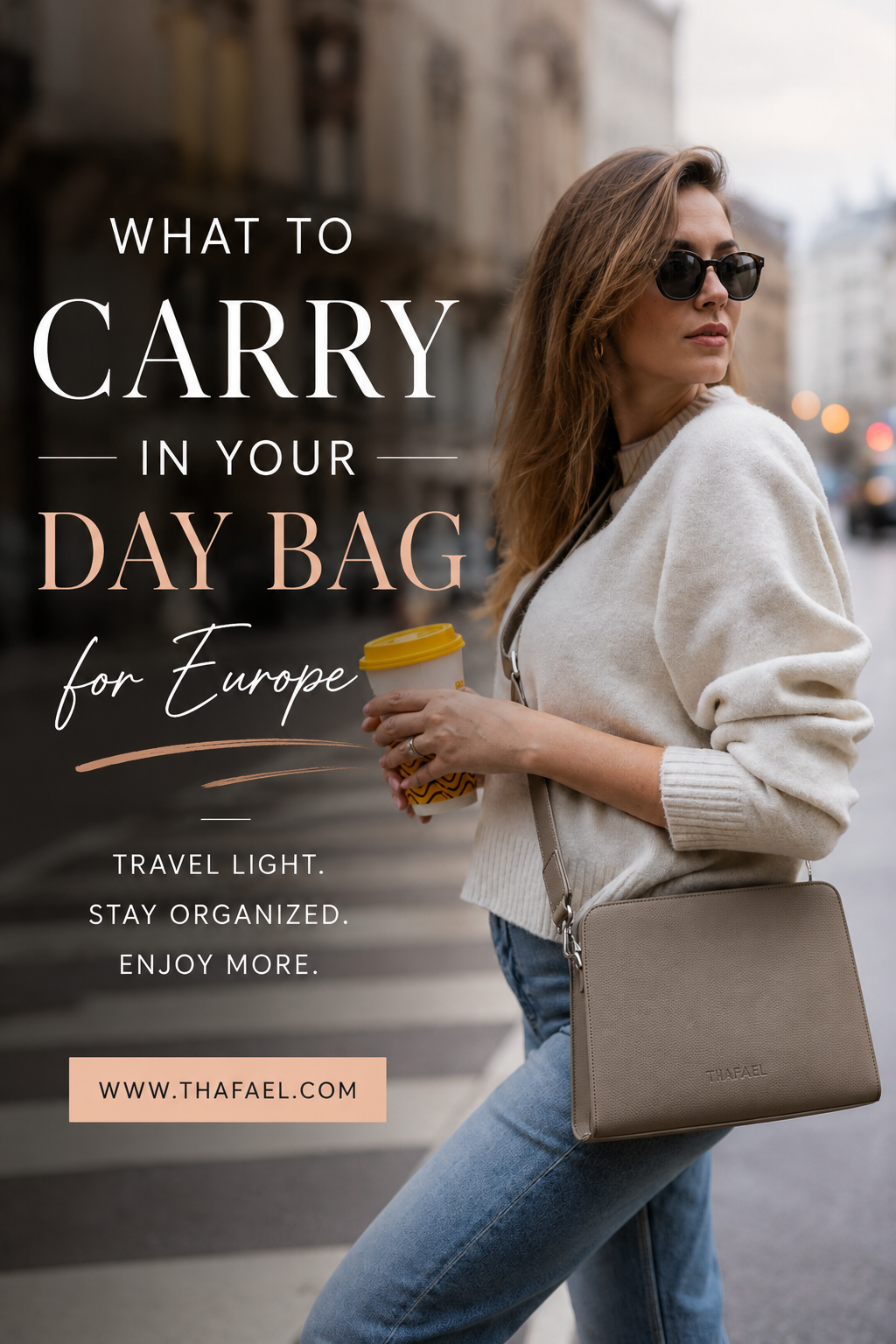
What to Carry in Your Day Bag for Europe (Essentials for Safe City Travel)
The essentials for a day bag in Europe are a secure crossbody bag, your phone, a fully charged power bank, a slim wallet or card holder, your passport or a secure copy, sunglasses, lip balm, and sunscreen. That is it. Everything else stays at the hotel.
Europe is one of the most beautiful places in the world to explore. It is also home to some of the most active pickpocketing environments on earth. Paris, Rome, Barcelona, and London consistently rank among the top cities globally for tourist-targeted theft. What you carry in your day bag and how you carry it makes a real difference to how safe and how free you feel throughout the day.
This guide tells you exactly what to pack, what to leave behind, and how to carry it all so your attention stays on the city and not on your belongings.

Key Takeaways
- The only essentials are your phone, power bank, passport or copy, one card and small amount of cash, sunglasses, lip balm, and sunscreen. Everything else stays at the hotel.
- A secure anti-theft crossbody worn in front of your body is the single most important day bag choice you can make in Europe.
- Carry only the cash you need for that day. Leave backup cards at your accommodation.
- Your phone is one of the most commonly stolen items in European cities right now. Keep it in your bag, not in your hand.
- A fully charged power bank is as essential as your passport for a full day of city exploring.
- Overpacking your day bag is one of the most common mistakes. A heavy crossbody becomes uncomfortable fast on cobblestone streets.
Table of Contents
- What should you carry in your day bag for Europe?
- What are the 7 essential items for a European day bag?
- Do you need to carry your passport in Europe every day?
- Should you carry a wallet in your day bag in Europe?
- Why is a power bank essential for a day trip in Europe?
- What bag should you carry as a day bag in Europe?
- What should you not carry in your day bag for Europe?
- How should you carry your bag safely in crowded European cities?
- What is the most common day bag mistake women make in Europe?
- FAQ
What Should You Carry in Your Day Bag for Europe?
The essentials for a European day bag are: a secure anti-theft crossbody, your phone, a fully charged power bank, a slim card holder or wallet, your passport or a secure copy, sunglasses, lip balm, and sunscreen. That is everything you need for a full day in any European city. Anything beyond this list should stay at your accommodation.
The goal is not to pack for every possible scenario. The goal is to carry what you actually need for that specific day, in a bag small enough to keep close to your body, organized well enough that you never have to open it in a crowded area looking for something.
A lighter bag means a more comfortable day. A more comfortable day means you actually enjoy the city you traveled to see.
What Are the 7 Essential Items for a European Day Bag?
1. A Secure Anti-Theft Crossbody Bag
This is the item that ties everything else together. How you carry your belongings matters as much as what you carry.

The bag I always travel with across Europe is the Thafael anti-theft crossbody bag, a cross body bag and practical cross body option that keeps valuables easier to access and more secure than carrying them behind you, and it is the reason I move through crowded European cities without the constant low-level anxiety of monitoring my belongings. It has locking zippers to deter thieves so no one can access it in a compressed metro crowd without me noticing. The straps and lining are slash-resistant so it cannot be cut off my body. RFID-blocking card pockets add rfid protection and protect my card data from wireless skimming. An anchor clip lets me secure it to a chair leg at a café so a snatch-and-run grab while I am looking at the menu is not possible, and the main compartment stays streamlined and easy to monitor.

It looks like a regular sleek crossbody. Nothing about it signals security bag or tourist. In Paris, Rome, Barcelona, and London, it fits the environment completely.
Choosing the right bag makes all the difference between a trip where you are constantly checking your belongings and one where your attention is fully on the experience.
👉 See how the Thafael crossbody is built for exactly this kind of travel.
👉 Related: What Is the Safest Bag for Europe Travel? (Anti-Theft Features That Actually Work).
2. Your Phone — and Why It Is a Target
Your phone is your map, your payment method, your camera, and your translator. It is also one of the most commonly stolen items in European cities right now. Phone snatching directly from hands has increased significantly across Barcelona, Rome, London, and Paris in recent years.
Keep your phone in your bag rather than in your hand when walking through crowded areas. Check your route before you step out of the metro rather than consulting your screen on the pavement. Take your photos and put the phone away before moving on. A phone in your bag is secure. A phone in your hand on a busy tourist street is a visible and easy target.
3. A Fully Charged Power Bank
Google Maps running all day in an unfamiliar city drains your battery faster than you expect. Add photography, music, translation, and occasional video calls and you can be at 20 percent battery by mid-afternoon.
I learned this the hard way last September in Europe. My power bank had not charged properly overnight and by mid-morning my phone was dying. No maps. No hotel address. No way to contact anyone. My sister was with me that day and she saved the situation entirely. If I had been alone I would have spent the rest of the day completely lost, with no directions and no way to reach anyone. Your phone is everything in a European city. Charge your power bank the night before. Check it before you leave. It is just as essential as your passport for a full day of exploring.
4. A Slim Card Holder Instead of a Bulky Wallet
The best move is to find a bag with built-in card pockets and a cash slot so you do not need a separate wallet at all. A bulky wallet takes up space, creates an obvious bulge, and contains far more than you need for a single day.
My crossbody has multiple card slots and a cash pocket built in, which means I leave my wallet at the hotel entirely. Before you go out, carry only the cards you will actually use and the cash you plan to spend that day. Leave your backup cards at your accommodation. If your bag is accessed, you want options waiting for you back at base.
5. Your Passport or a Secure Copy
You do not always need to carry your full passport, though Italy is a notable exception where carrying it may be required. I was reading some forums the other days and 2 travelers said that they were asked by Italian police to show their passport. In most EU countries, a photo of your passport's data page saved to your phone or a printed copy is sufficient for daily exploring. Check the entry requirements for each country you visit.
When you do need your physical passport, keep it in a dedicated RFID-blocking pocket inside your bag, ideally a secure internal pocket that is less visible or tucked into hidden pockets to deter pickpockets. Never carry your passport and all your backup documents together in the same compartment. If that one compartment is accessed, everything is gone at once.
When you do need your physical passport, keep it in a dedicated RFID-blocking pocket inside your bag. Never carry your passport and all your backup documents together in the same compartment. If that one compartment is accessed, everything is gone at once.
6. Sunglasses
Sunglasses are practical, lightweight, and work across every European destination. Even cities known for unpredictable weather get genuinely bright sun and sunglasses instantly elevate the simplest outfit, which matters when you are moving between sightseeing and dinner without a full outfit change. Keep them in an accessible compartment or a dedicated pocket so they stay easy to reach without mixing with other stuff every time the sun comes out.
7. Lip Balm and Sunscreen
European summer sun is strong, particularly in southern destinations like Spain, Italy, and Greece. SPF 30 or higher in a travel-size tube is worth the small amount of space it takes. Keep both in the most accessible compartment of your bag alongside your transit card and other daily-use items so you are not opening secure compartments repeatedly in public for small things.
Do You Need to Carry Your Passport in Europe Every Day?
No, not in most cases. In most EU countries a photo of your passport's data page saved to your phone or a printed copy is sufficient for everyday exploring. Physical passport carrying is generally only required for border crossings, checking into accommodation, or specific entry requirements for certain attractions.
When you do carry your physical passport, keep it in a dedicated RFID-blocking inner pocket, never loose at the top of a general compartment. And never carry your passport together with all your backup cards and cash in the same place. If that one spot is compromised, you lose everything simultaneously.
Should You Carry a Wallet in Your Day Bag in Europe?
Not if your bag has built-in card pockets and a cash slot. A traditional bulky wallet is one of the most unnecessary items most women pack into their day bag in Europe. It takes up space, creates an obvious bulge, and typically contains far more cards and cash than you need for a single day out.
The smarter move is a bag with card slots and a cash pocket built directly into the lining. This means one less item in your bag, less bulk on your body, and no need to pull out a wallet in crowded public spaces. Transfer only the cash and cards you need for that specific day and leave everything else at your accommodation.
Why Is a Power Bank Essential for a Day Trip in Europe?
A power bank is essential for a day trip in Europe because your phone handles navigation, translation, payment, photography, and communication simultaneously across a full day of city exploring. That level of use drains a standard phone battery well before evening.
Google Maps alone running continuously in an unfamiliar city is enough to drop your battery significantly by early afternoon. Add a few hours of photography, music, and occasional translation and a dead phone by 4 PM in a city where you do not speak the language and do not know your way around is a genuinely stressful situation.
Charge your power bank every night before you go out. Check that it is full before you leave the hotel in the morning. A dead power bank is as useless as no power bank at all.
What Bag Should You Carry as a Day Bag in Europe?
The best day bag for Europe is a small to medium anti-theft crossbody worn across your chest in front of your body. Because you may wear it for long hours of walking, comfort matters as much as security, and water resistant materials help protect contents from rain. It should have lockable zippers, slash-resistant straps and lining, RFID-blocking card pockets, and an anchor clip for securing to furniture.
Here is why each feature matters in a European city:
Locking zippers prevent access in compressed metro crowds and busy tourist queues where you cannot feel what is happening near your bag.
Slash-resistant straps and lining mean the bag cannot be cut off your body or sliced open from underneath, which is a documented theft method in cities like Barcelona and Rome.
RFID-blocking card pockets protect your contactless card data from wireless skimming devices, which are used in crowded transit environments.
An anchor clip lets you secure the bag to a chair leg at a café or restaurant, removing the snatch-and-run scenario entirely.
Worn in front of your body, a crossbody keeps your bag in your line of sight at all times and eliminates the blind spot that backpacks and shoulder bags create. Among the key features to check, bags fit best when the strap adjusts cleanly to your frame and the design feels ergonomic for daily city exploration. If you prefer a style with shoulder straps, padded shoulder straps and breathable shoulder straps reduce strain on heavy walking days.

The Thafael anti-theft purse has all of these features and fits a power bank, a compact umbrella, a small scarf, and your daily essentials without losing its shape or pulling on your shoulder. It works well as a personal item, and unlike a small backpack, it stays visible in crowds. The built-in card pockets and cash slot mean no separate wallet needed. Everything you need for a full day lives in one bag, on your body, where you can see it. That makes it the best travel bag for travelers who want simplicity, while the best backpack still suits those who need more capacity.
👉 See the Thafael crossbody handbag for travel.
You can also read that guide to learn why it's the the best bag for sightseeing in Europe
What Should You Not Carry in Your Day Bag for Europe?
All your cash. Carry only what you need for that day. Leave the rest in your accommodation safe or a secure location.
Multiple credit and debit cards. One card for daily use and one backup card left at the hotel. If your bag is accessed, you want options waiting for you back at base.
Your passport and all backup documents together. Never keep everything in one place. If that one place is compromised, you lose everything simultaneously.
Expensive jewelry and watches. Save them for evenings in lower-risk settings. Visible luxury items in crowded tourist areas increase your visibility as a target.
Too much in general. This is the mistake most women make without realizing it. A crossbody bag is designed to carry your daily essentials close to your body, not everything you own for the trip. Overpacking your day bag means it sits heavier on your shoulder, pulls at your neck, and becomes uncomfortable long before the day is done. After a few hours of walking cobblestone streets, that extra weight adds up fast. Pack only what you genuinely need for that specific day and leave the rest behind, especially extra clothes and bulky extras unless the weather clearly calls for them. A slim water bottle for refilling at fountains is useful because it takes up very little room. A small pack towel is about 5 inches square and is fine, but larger wet items can turn the entire bag into clutter. Water-resistant materials also help protect the contents from rain.
How Should You Carry Your Bag Safely in Crowded European Cities?
Having the right bag is the foundation. Using it correctly completes the system.
Wear your crossbody in front of your body. Not on your back, not dangling from one shoulder. Across your chest with the bag resting in front. This keeps it in your line of sight at all times and eliminates the blind spot pickpockets rely on. Some travelers switch to a small cross body purse or even a purse for evening outings, but for crowded city sightseeing the more secure anti-theft crossbody setup is still the better choice.
Keep the zippers locked at all times in crowded areas. Not just when you feel at risk. Always. Pickpockets do not announce themselves and the most professional ones operate in situations that feel completely normal. Visible anti-theft features also help deter thieves in high-risk areas.

Clip your bag to your chair at cafés and restaurants. Never hang it on the back of your chair. Loop the strap around a chair leg or use the anchor clip. It takes two seconds and removes one of the most common theft scenarios entirely.
Be especially aware in Barcelona and Rome. Barcelona consistently tops European pickpocketing reports. Rome's tourist areas, particularly around the Colosseum, the Trevi Fountain, and central metro stations, are consistently flagged. In both cities the combination of crowds, distraction, and professional operations makes bag security non-negotiable.
Avoid open totes in city environments. A tote is appropriate for a local market at home. In the crowded tourist areas of Rome, Paris, or Barcelona, an open tote is the easiest possible target.
Keep your phone in your bag when walking. Not in your hand, not in a back pocket. In your bag, zipped and locked.
If you're traveling through several countries, our guide on how to avoid pickpockets in Europe explains the common scams you'll encounter and the habits that prevent most thefts.
What Is the Most Common Day Bag Mistake Women Make in Europe?
The most common mistake is not what you pack. It is carrying the wrong bag and spending the whole day managing the anxiety that creates.
An open tote or a backpack worn on your back in a crowded European city means you are constantly aware of your belongings in a low-level, draining way. You check the bag. You shift it. You tighten your grip in crowds. You look back at it when you sit down. None of that is enjoyment. It is overhead.
The second most common mistake is overpacking the bag itself. A crossbody bag is designed to sit close to your body and carry your daily essentials, not function as a second suitcase. Some people treat it like backpack luggage or expect it to do the job of a larger bag, and that is exactly what creates discomfort. When you overpack it, the weight pulls on your shoulder and neck across hours of walking. By the time you reach your third museum or your evening restaurant, your shoulder aches and the bag feels like a burden rather than a tool.
The third mistake is how you treat the bag once you sit down. Hanging it on the back of your chair, leaving it unattended on a table, or carrying a secure bag without actually using its security features defeats the purpose entirely. A locking zipper that is never locked is just a zipper. An anchor clip that stays clipped to your strap instead of your chair leg is just decoration. The bag only works if you use it correctly. Lock the zippers in crowded areas. Clip the bag to the chair every single time you sit down. Keep it in front of your body when you are standing. These habits take seconds and they are the difference between a bag that protects you and a bag that just looks like it does.
The goal is to feel free, not stressed. A smaller day bag works better in a new city because it stays easy to manage and keeps your focus off your belongings. A well-organized secure crossbody with only what you actually need, worn correctly and used properly, means you leave the hotel and forget about your bag entirely until you need something from it. That is the standard worth aiming for.
Conclusion
Packing a smart day bag for Europe is not about fear. It is about ease.
When you carry only what you need, in a bag designed to protect it, organized so you always know where everything is, you move through European cities differently. You are not clutching your bag in crowds. You are not checking it every few minutes. You are not distracted by the low-level anxiety of feeling vulnerable.
You are just there. In Rome. In Paris. In Barcelona. Fully present.
That is what smart packing actually buys you. Not just security. Freedom.
Happy and Safe Travels!
Arielle
FAQ
What should you carry in your day bag for Europe? The essentials are a secure anti-theft crossbody bag, your phone, a fully charged power bank, the cash and cards you need for the day, your passport or a secure copy, sunglasses, lip balm, and sunscreen. Everything else stays at the hotel. The goal is to carry only what you need for that specific day in a bag small enough to keep close to your body at all times.
What size day bag is best for Europe? A small to medium crossbody bag is the ideal size. Large enough to hold your phone, power bank, card holder, and daily essentials. Small enough to stay close to your body and not encourage overpacking. A bag that is too large becomes heavy and uncomfortable across a full day of city walking and makes you a more visible target because it signals you are carrying more.
Is it safe to carry a backpack in Europe? Less safe than a crossbody, particularly in crowded tourist areas and on public transport. A backpack worn on your back cannot be monitored and can be unzipped and accessed without you noticing in a crowd. If you use a backpack, wear it on your front in busy environments and store valuables in inner compartments only. For day-to-day city exploring a crossbody is the safer and more practical choice.
Should I carry my passport everywhere in Europe? Not in most cases. In most EU countries a photo of your passport's data page saved to your phone or a printed copy is sufficient for everyday exploring. When you do carry your physical passport keep it in a dedicated RFID-blocking pocket inside a secure bag, never loose in an outer compartment or general pocket.
What bag is safest for travel in Europe? A crossbody anti-theft bag worn in front of your body. Look for lockable zippers, slash-resistant straps and lining, RFID-blocking card pockets, and an anchor clip for securing to furniture. These features cover the specific theft scenarios most common in European cities and keep your belongings in your line of sight at all times.
How much cash should I carry in my day bag in Europe? Only what you need for that day. Cards are accepted almost everywhere in Western Europe including on public transport, in restaurants, cafés, and most markets. Keep a small amount of cash, for very small vendors, cash-only spots, or emergencies. Leave the rest at your accommodation.
What is the best way to organize a day bag for Europe? Keep your most-used items in the most accessible compartment: phone, transit card, lip balm, sunscreen. Keep valuables including your passport, cards, and cash in a dedicated secure or RFID-blocking pocket that you do not open repeatedly in public. The goal is to know exactly where everything is without opening your bag in crowded areas.
Do you need a wallet in your day bag in Europe? Not if your bag has built-in card pockets and a cash slot. A bag with card slots built into the lining eliminates the need for a separate wallet entirely, reduces bulk, and means one less item to manage or lose. Transfer only the cards and cash you need for that day and leave everything else at your accommodation.
About the Author
Arielle is the founder of Thafael, a travel accessories brand built around one idea: that women should not have to choose between feeling safe and feeling stylish when they travel. She created Thafael's anti-theft crossbody bag, after realizing that most secure travel bags looked exactly like what they were: functional, obvious, and nothing she actually wanted to carry. Thafael is named after her two children, Thaliya and Rafael, which is as good a reason as any to build something that lasts. She writes about European travel, packing smart, and moving through the world with a little more ease and a lot more confidence.



Leave a comment
This site is protected by hCaptcha and the hCaptcha Privacy Policy and Terms of Service apply.