
How Do RFID-Blocking Bags Work? A Practical Guide to Shielding and Its Limits
How do RFID-blocking bags work? In short, a thin conductive layer is built into a pocket so that a reader's radio signal has a harder time reaching the chip inside a card or passport. That is the whole idea, and it comes with limits worth understanding before you decide how much it matters. This guide explains, in plain language, how contactless chips communicate, where shielding interrupts that conversation, what RFID blocking can and cannot do, and how to check what a bag really protects before you pack it for Europe.
RFID Blocking in a Bag: The Short Answer
So how do RFID-blocking bags work in practice? Here is the short version. A contactless card or passport chip has no battery. It wakes up only when a reader's radio field reaches it. RFID-blocking material, usually a thin layer of metal foil, mesh or metal-coated fabric, is placed around a pocket so that the field is weakened before it gets to the chip. With too little energy arriving, the chip stays silent.
People searching for the RFID blocking meaning usually want one thing: to know whether it makes a bag safer. The honest answer is that it does one narrow job. It limits wireless reading of the cards and documents inside a shielded pocket. It does not stop anyone from taking the bag, and it does not make a bag "secure" on its own.
Most handbags also shield only specific pockets rather than every surface, so the details of which pocket is protected matter more than the label on the tag. THAFAEL's La Trotteuse anti-theft crossbody bag is built this way, with RFID protection in 10 interior pockets, and we explain exactly where below.
What RFID and NFC Mean in Everyday Use
RFID stands for radio-frequency identification: a reader sends out a radio signal, and a tag or chip answers. NFC, or near-field communication, is a short-range member of the same family that works at 13.56 MHz. The NFC Forum, the industry body behind the standard, describes a typical range of up to about 2 cm, and the ISO/IEC 14443 standard used by contactless cards and passports is designed for reading at roughly 10 cm at most.
In a travel bag, the items with chips are usually your contactless bank cards, transit cards, hotel and office key cards, and your electronic passport. Some car key fobs also contain radio chips, though they work differently, as you will see below.
So what does RFID blocking mean for those items? In practice, it means a material that interferes with the radio signal a chip depends on. And what is RFID blocking technology beyond that? It is less high-tech than it sounds. There are no electronics or batteries involved, just the right materials in the right places.
How a Reader Communicates With a Contactless Chip
So how does RFID blocking work? To answer that, it helps to see first what happens without it.
A contactless card carries a tiny chip connected to a flat coil of wire, which acts as its antenna. A reader, such as a payment terminal or a transit gate, has its own coil that produces a rapidly alternating magnetic field at 13.56 MHz. When the card comes close, that field passes through the card's coil and induces a small electric current, just enough to wake the chip. The chip then answers by subtly changing how much power its coil draws, and the reader picks that up as a signal.
Because the chip is powered by the reader, it is called passive. The NFC Forum notes that this one-sided power transfer is what allows battery-less operation.
This is also why distance matters so much. The field fades quickly as you move away from the reader's coil, so contactless cards are designed to work within a few centimeters.
That range is a design target, not a physical wall. In a paper presented at USENIX Security in 2006, researchers Ilan Kirschenbaum and Avishai Wool described a home-built skimmer that read ISO 14443 tags from about 25 cm, compared with a nominal 5 to 10 cm. It used a 40 cm-diameter copper-tube antenna, a 12-volt battery and roughly $100 of hobbyist parts. It was a laboratory demonstration, not a pocket-sized gadget, but it shows why "a few centimeters" should not be treated as a guarantee.
Reader → Radio Field → Chip: Where Shielding Interrupts Communication
Think of the exchange as a chain: reader, radio field, chip. How does RFID blocking work within that chain? It acts on the middle link.
When a conductive layer sits between a reader and a chip, the reader's alternating field induces small currents in that layer. Those currents create a field of their own that pushes back against the original, and some of the energy is reflected or lost as heat. The result is that less of the reader's signal reaches the card's coil. If it is too little to power the chip, the chip never answers.
The reduction in signal strength is called attenuation, and it is usually measured in decibels. A material that weakens a signal a lot is not the same as one that blocks it completely, which is why a bag that cites measured attenuation tells you more than one that simply says "blocks RFID."
Two practical points follow. First, shielding only works against the frequencies it was designed for. Second, it only works where the conductive layer actually surrounds the chip, which brings us to coverage.
How Does RFID-Blocking Material Work?
What is RFID blocking material made of? Most products use a thin conductive layer: metal foil, a fine metal mesh, or fabric coated with a metal such as copper or nickel. The layer is usually laminated between the outer fabric and the pocket lining, so you cannot see or feel it. Conductivity is the key property. The better a layer conducts, the more effectively it pushes back against the reader's field.
Because the material is passive, it does nothing until a reader's field arrives, and it needs no charging. But constructions differ. Foil, mesh and coated fabric vary in how continuous the layer is, how well it survives bending and washing, and how well it performs across frequencies. Without published test results, you cannot judge that from the outside.
Conductive Layers, Coverage and the Shielded Compartment
Coverage matters as much as the material. A pocket lined on all sides, with the lining overlapping where the zip or flap closes, leaves the field fewer ways in than one lined on a single side. Gaps at seams or an open top can let a signal leak through, especially if a card sits partly outside the pocket.
The practical rule is simple: keep each card fully inside the shielded area. Whether a particular design still works with a card half out is something only testing can answer.
You may read that zippers always shield better than flaps or open pockets. That is too broad. Closure type can affect how well the lining overlaps at the edges, but what counts is continuous coverage and how the closure is built, not the hardware alone.
Why the Frequency and the Product's Construction Matter
RFID is a family of technologies, not one. According to NIST's guidelines for securing RFID systems, low-frequency systems around 125 to 134 kHz are used in some access control and car immobilizers, high-frequency systems at 13.56 MHz are used in smart cards and access control, and ultra-high-frequency systems at roughly 860 to 960 MHz are used for logistics and tracking.
For travelers, the relevant ones are these. Contactless bank cards and electronic passports use ISO/IEC 14443 at 13.56 MHz. Hotel and office cards may use either 13.56 MHz or an older low-frequency system. Vehicle key fobs usually rely on other radio bands again, so a pocket designed for 13.56 MHz cards should not be assumed to shield one.
That is why a product's stated frequencies are worth reading. A lining tuned and tested for 13.56 MHz tells you something. A lining that claims to block "all signals" tells you very little.
RFID Pockets, Card Sleeves and Faraday Bags Compared
These three products are often lumped together, but they do different jobs.
| Product | What it covers | Watch for |
|---|---|---|
| Shielded bag pocket | Cards and passport stored in that lined pocket only, not the rest of the bag. Best for everyday storage while traveling. | Which pockets are lined, and whether cards sit fully inside. |
| Card sleeve or RFID wallet | One card or a few cards inside the sleeve, for extra separation. | Cards must be fully enclosed; thin foil can crease. |
| Faraday pouch or bag | Anything sealed inside, such as a phone or key fob, when fully closed. Used to cut a device off from wireless signals. | Needs published multi-band test results; the device inside cannot receive calls or signals. |
Does the Whole Bag Block RFID, or Just One Pocket?
Usually just one pocket, or a few designated areas. A bag with a shielded card slot behaves like any other bag everywhere else. That is normal, not a flaw, but it means you need to know which pocket is which.
La Trotteuse, THAFAEL's anti-theft purse, has 10 RFID-protected pockets inside: 7 card pockets, 1 passport pocket and 2 additional open pockets. The same bag has lockable main zippers, a lockable hidden back pocket, slash-resistant lining and an adjustable strap with slash-resistant webbing, features designed to help reduce the risk of opportunistic theft rather than eliminate it.
That level of detail is what to look for in any bag: which pockets, which items, and what the maker can say about how the protection was verified.

La Trotteuse Anti-Theft Crossbody Bag
10 RFID-protected interior pockets, lockable zippers, slash-resistant lining and strap, in a bag that looks like an everyday purse.
Read the Product Specification Before Deciding Where to Store Cards
Treat the product page like a label. A line such as "RFID-protected card and passport pockets" tells you where to put things. A line such as "blocks hackers" tells you nothing.
Once you know which pockets are shielded, plan your layout: bank cards, transit cards and passport in the marked pockets, and your phone and power bank in ordinary compartments. If a bag does not identify a shielded pocket, assume it does not have one. And if the specification does not mention frequencies or testing, treat the RFID claim with caution.
What RFID Blocking Can and Cannot Protect Against
RFID blocking limits the wireless reading of chips inside the shielded area. That is all. It does not stop someone from stealing a wallet or a bag, it does not prevent phishing, data breaches or online fraud, and it does not affect magnetic-stripe skimming at a compromised ATM, which is a different technology entirely.
A Barrier to Compatible Radio Communication, Not Physical Theft
So does RFID blocking really work? Within limits, yes. Inside a well-made shielded pocket, a compatible reader's field is weakened enough that the chip should not answer, as long as the material was designed for that frequency and the card is properly placed. It does not lock or disable the card. It simply reduces what reaches it.
Physical theft is a separate matter. In busy tourist areas, the practical risk is more often a bag, phone or wallet being taken than a card being read wirelessly. Wearing your bag crossbody, keeping zippers closed and staying aware of crowds do more here. Our guide on how to avoid pickpockets in Europe covers those habits in detail, and learning how to not look like a tourist in Europe helps you move through crowds with less attention.
Why RFID Blocking Is Not the Same as Phone, GPS or Bluetooth Blocking
Phones communicate on cellular, Wi-Fi, Bluetooth and GPS bands that are very different from the 13.56 MHz used by contactless cards. A pocket designed for cards will not stop a phone from receiving calls or being located.
A Faraday pouch is built for a different purpose. Even then, how many signals it blocks depends on its construction and the bands it was tested on, so no pouch should be assumed to block every wireless signal. If you want that level of isolation, look for published test results across the specific bands you care about.
Is RFID Blocking Necessary for Travel?
For most travelers, it is an optional extra rather than a necessity. AARP's reporting on RFID wallets and purses quotes fraud and identity-theft experts who describe RFID skimming scams as largely theoretical and unheard of in practice, and advise people not to spend extra on protection against them.
That does not make the idea pointless. Researchers have shown in the lab that a skimmer can read a card from beyond its nominal range, and that relay attacks are possible in principle. But those demonstrations required specialized equipment, and documented real-world cases are hard to find. If your bag already has a shielded pocket, using it costs you nothing. If it does not, RFID protection alone is not a reason to buy a different one. Judge a travel bag on its physical security first.
Is RFID blocking really necessary on a trip to Europe? The most honest answer is that it is a sensible extra layer in crowded places such as busy metros, queues and markets, not a safeguard you must have.
Using RFID-Protected Pockets on Trips and at Home
Contactless readers are everywhere: payment terminals, transit gates, hotel doors, building entrances. At home you know your routine and your surroundings. In a new city, you are passing through unfamiliar stations, crowded squares and queues, often with your passport and several cards on you at once. Documented cases of wireless card skimming are rare, but keeping your chips in a shielded pocket costs nothing, and it is one more layer on a day when you have a lot to keep track of.
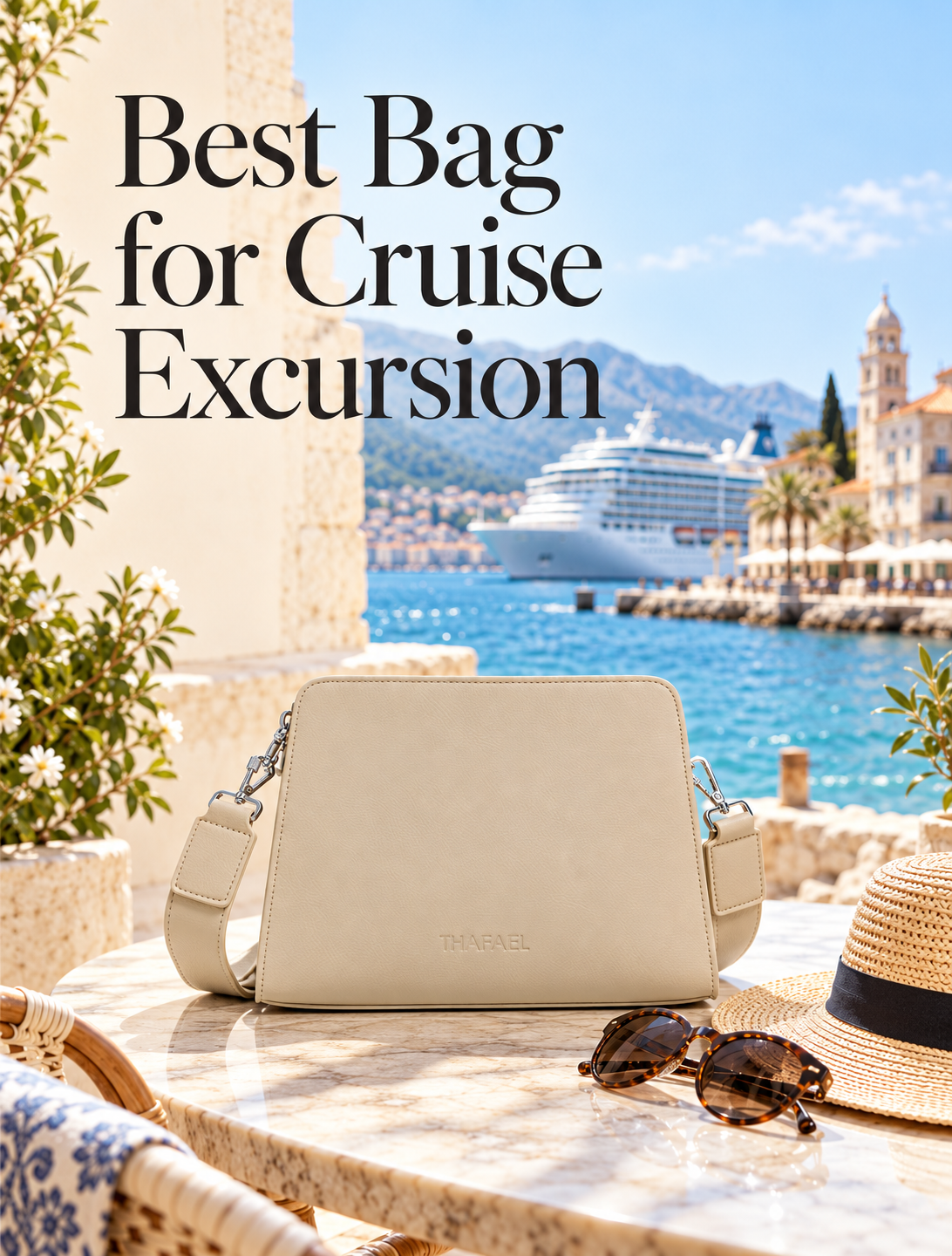
Wherever you are, the habit is the same: keep the items with chips together in the pockets meant for them. On a trip to Europe, that might be your passport and a few contactless cards as you move through train stations, metros and busy squares. On a cruise, it could be your passport, your cabin key card and a payment card as you go between the ship and the port. On a weekend in another country, or an ordinary day in your own city, it can simply be your bank cards and transit pass.
La Trotteuse is designed for this kind of everyday carrying. It has 10 RFID-protected pockets: 7 card pockets, 1 passport pocket and 2 additional open pockets. The RFID protection is designed to help reduce the risk of wireless scanning of what is inside those pockets. It is not a substitute for ordinary care, which is why the bag also has lockable main zippers and a lockable hidden back pocket for the moments RFID protection can't help with, such as a crowded platform or a busy market.
See how the pockets are arranged on the product page.
Contactless Payment Security and the Limits of Skimming Claims
Contactless cards do not simply broadcast your details. Each tap generates a one-time code for that transaction, so a captured code cannot easily be replayed, and the security code printed on your card is not transmitted. Some data, such as the card number, may still be readable, which is why bank alerts and strong account security matter more than any single accessory.
Many card issuers also protect customers against unauthorized transactions, but the terms differ by bank and country, so check yours before you travel.
Passport Chips Have Their Own Access Controls
Is RFID blocking necessary for passport chips? Usually it is optional. Electronic passports are designed so that the chip does not simply hand over its data to any reader that comes near.
Under the international standard for travel documents, ICAO Doc 9303 Part 11, the chip's data is protected by access-control mechanisms. Basic Access Control (BAC) requires a reader to first obtain information printed on the passport itself, then sets up an encrypted session. A newer mechanism called PACE strengthens this further. In both cases, a reader needs physical access to the document, or to what is printed on it, before the chip will respond.
U.S. passports also include anti-skimming material in the front cover and spine, designed to work when the book is closed or nearly closed, according to the State Department's 2005 final rule on electronic passports. Other countries' passports vary, so do not assume yours has it. The same rule notes that the U.S. chip holds the data-page information and a digital photograph, not home addresses or Social Security numbers.
A shielded pocket is a reasonable place to keep a passport, and it is one reason travelers like a bag with a dedicated card and passport area, such as the one in this anti-theft travel bag. But it is not the main safeguard. Keeping the passport closed and physically secure matters more.
How to Use an RFID-Blocking Pocket Correctly
Shielding only helps when the item is inside the lined area. Slide each card fully into the protected pocket, close the zip or flap completely, and keep your contactless cards and passport together in the marked area rather than scattered through the bag. Before you step into a crowded market or onto public transport, a quick check that everything is tucked in takes a few seconds.
Keep the Item Inside the Claimed Protected Area and Follow Closure Instructions
A card sticking out of a sleeve or a passport half outside a pocket may still be readable, even with shielding around part of it. Follow the maker's closure instructions, and check care guidance too. Creasing, washing or puncturing the lining can damage a conductive layer, so it is worth inspecting the pocket now and then for tears.
When you want to pay by tap, take the card out of the shielded pocket first, then put it back.
How Can You Check an RFID-Blocking Claim?
The strongest evidence is independent laboratory test data that names the frequencies tested and the results. Without that, a simple home check can show whether a pocket makes a noticeable difference for one card and one reader.
Confirm the Reader Works, Repeat With the Protected Pocket, Record the Setup
Try this with a card you do not mind handling and a reader you can use freely, such as a self-checkout terminal or an office door reader.
- Tap the card on the reader with no shielding, to confirm the reader accepts it.
- Place the card fully inside the shielded pocket, close the compartment, and try the same tap.
- Note the reader, the pocket and whether the tap was blocked.
- Repeat with the card in a slightly different position, to see whether the result is consistent.
A Home Check Is Not Proof of Every Frequency or Laboratory Certification
Passing this check tells you the pocket works for that card, that reader and that position. It does not prove it blocks other frequencies, other readers or a very strong reader.
You may also see a product cite MIL-STD-188-125. That is a U.S. military standard for protecting ground-based facilities against high-altitude electromagnetic pulse, written for fixed command and communications facilities. It is not a test method for a handbag pocket, so a citation of it should prompt the question: what exactly was tested, and how?
What to Ask Before Buying an RFID-Blocking Bag
Before you buy, ask specific questions rather than relying on vague marketing. A reputable brand should be able to answer most of these plainly, and be honest where it cannot.
Protected Area, Tested Frequencies, Test Evidence and Care Instructions
- Which pockets are shielded? Look for named pockets, and what each is meant to hold: cards, passport, or both.
- Which frequencies are covered? A claim for 13.56 MHz tells you more than "blocks all signals," and a key fob is a separate question.
- Is there test evidence? Ask whether the maker has laboratory or supplier test data, and what it measured. A "military-grade" claim without detail is a prompt to ask more.
- What are the care instructions? Find out whether washing, folding or sharp objects can damage the lining.
- What else does the bag do? RFID protection is one feature. Lockable zippers, slash-resistant lining and strap address the more familiar risks, and La Trotteuse, our RFID-protected crossbody bag, combines all of these. Our guide on how to choose an anti-theft bag for your travel needs walks through those, and you can browse our anti-theft crossbody bags for women to see how they come together.
Frequently Asked Questions About RFID-Blocking Bags
Do RFID-blocking bags need batteries?
No. RFID-blocking bags are passive. They rely on conductive materials such as metal foil, mesh or metal-coated fabric to weaken the reader's signal, so there is nothing to charge or switch on.
Will every pocket in an RFID-blocking bag protect my cards?
Not necessarily. Usually only designated pockets are shielded, and the rest of the bag works like any other handbag. Check the product description or internal labels, and keep cards and your passport in the marked pockets. On La Trotteuse, the RFID protection is in its 10 interior pockets (7 card pockets, 1 passport pocket and 2 open pockets) rather than the whole bag.
Can RFID blocking stop a phone from being tracked?
No. A card pocket designed for contactless cards does not stop a phone from using cellular, Wi-Fi, Bluetooth or GPS signals. Only a purpose-built Faraday pouch, tested across the relevant bands, can cut a phone off from wireless signals, and even then you should rely on its published test results, not assumptions.
Can I tap to pay while my card is inside the protected pocket?
You should not be able to if the pocket is working. A well-shielded pocket is designed to stop readers from reaching the card, so take the card out for each tap and put it back afterwards. If a payment goes through with the card inside, the pocket may not be shielding effectively, but a single tap is not proof either way. Terminals vary.
Does an electronic passport require an extra RFID-blocking sleeve?
Usually it is optional. Electronic passports have built-in access controls, and U.S. passports also include anti-skimming material in the cover. A shielded pocket or sleeve is a reasonable extra if you want one, but keeping your passport closed and secure matters more.
Can a phone test prove that a bag blocks every RFID signal?
No. A phone or NFC test shows how one card behaves with one reader in one position. Different RFID systems use different frequencies, so a home test cannot prove a bag blocks them all. For higher assurance, look for published, multi-frequency laboratory results.
RFID blocking is a modest feature that is useful to understand and easy to overrate. If your bag has a shielded pocket, use it properly and keep your expectations realistic. And keep your attention where it counts most in a crowd: on your bag, your phone and the people around you.
If you are looking for a bag that pairs 10 RFID-protected pockets with lockable zippers, slash-resistant lining and strap, take a look at La Trotteuse, our anti-theft crossbody bag for women, or browse the full anti-theft crossbody bag collection.
If you are packing for Europe, you may also like our guides on what to carry in your day bag in Europe, the best anti-theft bag for Europe and travel safety tips every woman should know.
Bon voyage!
Arielle
About the Author
Arielle is the founder of Thafael, a travel accessories brand built around one idea: that women should not have to choose between feeling safe and feeling stylish when they travel. She created La Trotteuse, Thafael's anti-theft crossbody bag, after spending time in Europe and realizing that most secure travel bags looked exactly like what they were: functional, obvious, and nothing she actually wanted to carry. Thafael is named after her two children, Thaliya and Rafael, which is as good a reason as any to build something that lasts. She writes about European travel, packing smart, and moving through the world with a little more ease and a lot more confidence.


Laisser un commentaire
Ce site est protégé par hCaptcha, et la Politique de confidentialité et les Conditions de service de hCaptcha s’appliquent.